05 · Architecture & Security

Layered architecture, on-premise deployment, governance built in

The server manages resources and data centrally; the Android agent talks to the system and enforces policy. The two sides cooperate over REST APIs and a command channel.

05 · Architecture & Security

Architecture: console + server core + plugins + on-device agent

Each layer has a clear responsibility, and the plugin design lets extensions arrive as modules.

Management app layer
Web consoleEnterprise Android consoleMonitoringAdmin entry
Access layer
Nginx / HTTPSREST API (CORS)
Server
OneNexus MDM Server (Java / Tomcat WAR)PostgreSQL
Extension layer
Device InfoDevice LogAuditMessagingPush
Communication layer
MQTT / Long PollingFile transfer (APK / data)Android Agent + Launcher
01

On-premise deployment

Web console, server, Tomcat and PostgreSQL are the baseline components, deployed inside the customer's own environment and network domain.

02

Single entry point

All external access goes through one Nginx + HTTPS entry; devices and the console both use the REST API.

03

Plugin-based extensions

Device info, logs, messaging and push arrive as components; each behaviour can be replaced or extended by the default implementation.

05 · Architecture & Security

Security and data boundaries: permission is responsibility

An MDM platform inherently holds device-level privileges, so OneNexus MDM builds permission governance and operation audit into the product, and defines the security boundary in writing at project kick-off as a baseline deliverable.

  • Deployed in an environment you control — the system runs on customer-provided Tomcat and PostgreSQL, in your data centre or a hosted cloud; the data path never leaves your infrastructure.
  • Encrypted transport — HTTPS certificates can be issued by your own operations team; the link between console and device is encrypted end to end.
  • Least privilege, separated roles — user, role and device group form a three-layer boundary; accounts receive only the scope they need.
  • Traceable operations — key actions are written to the audit log; platform operations and logs are auditable for security and compliance review.
  • Controlled artefacts — APKs, images and provisioning scripts are managed locally, so delivery never introduces uncontrolled sources.
  • Minimum necessary data collection — only the Android APIs and MDM permission data the platform needs are collected; exact fields are confirmed on site during implementation.
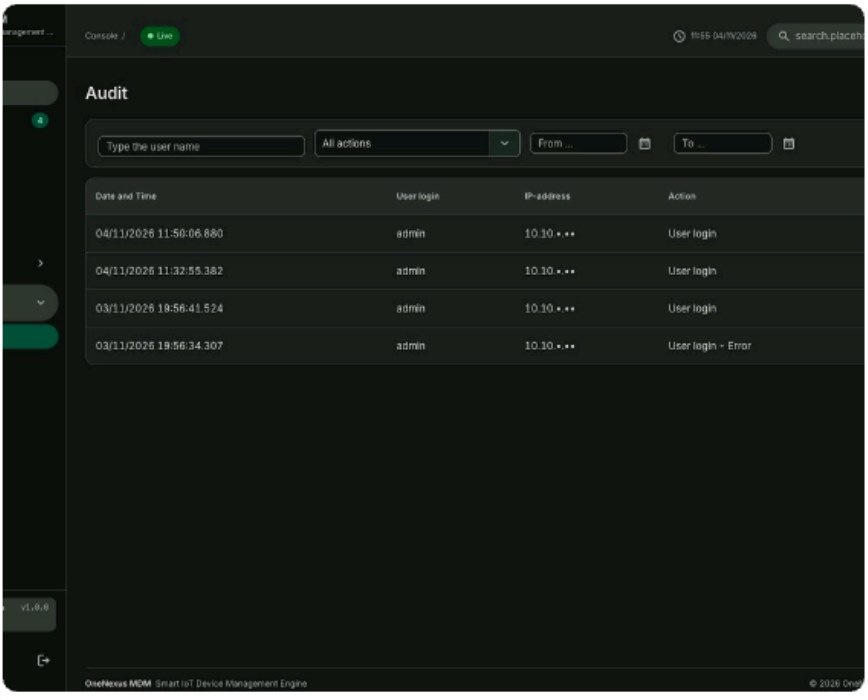
Audit log (live product)
Fig. 10 · Audit log (live product): action, object, IP, result and time, traceable per account
“What level of account touched this device, and what did it do?” — answered during initialisation and acceptance, as a check item for preventing privilege escalation and for customer sign-off; the boundary is agreed before any device enrolls.

Transparent architecture, clear boundaries

On-premise in your own environment, with permission governance and audit built into the product from day one.

Business enquiries: bd@ihuatek.com